


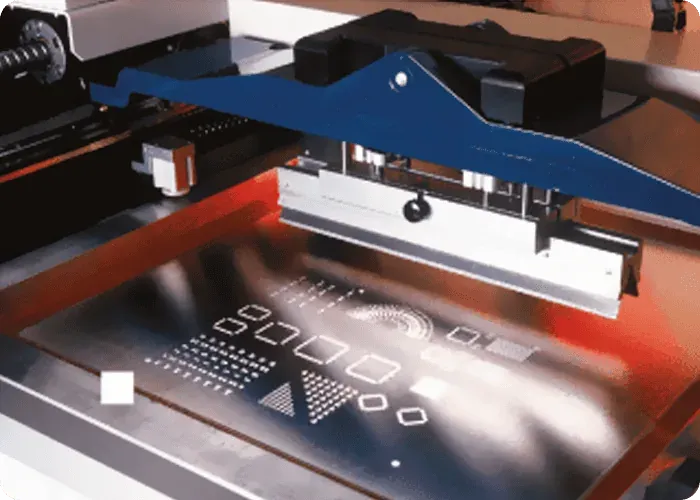
What goes on the printer is an assembly
Stencil conversations almost always stop at the apertures: shape, position, wall condition. But what actually gets clamped into the printer is an assembly of three parts — the frame, the mesh or adhesive connection, and the foil. The foil only determines where paste can pass. How that foil behaves at the moment of printing, what supports it, and how firmly it is held against the board are decided by the other two parts.
This distinction is not terminology for its own sake. Apertures are static geometry: you can measure them offline and check them against the data package. Tension is an assembly condition: it is established at the moment of delivery and changes continuously thereafter through use and cleaning. The two have different evidence types, different ownership, and different retirement logic. Treating them as one thing is exactly how a shop ends up attributing every print problem to apertures, recutting the stencil, and seeing no change.
What tension actually does during printing
Mounting tension carries three jobs, and each one changes the print result directly.
First, it determines how the foil meets the board. As the squeegee advances, the foil must stay in contact with the board surface, or paste bleeds sideways through the gap between aperture and pad. An under-tensioned foil lifts or dips locally under squeegee pressure, so contact varies along the print direction — and that variation is invisible in aperture data.
Second, it determines when separation happens. Whether paste releases cleanly onto the pad depends on how controlled the separation motion is. A well-tensioned foil springs back in something close to planar motion. An under-tensioned foil is drawn up with local deformation, so separation occurs at different points at different times, turning release from an instant into a process that propagates across the board.
Third, it determines how squeegee force is distributed. Part of the force the squeegee applies drives paste into apertures; part is absorbed by the tensioning structure. When tension is insufficient, more of that force converts into foil deformation and the effective wiping action changes. The usual operator reaction is to increase pressure, which amplifies the deformation further. This is a self-reinforcing wrong direction.
What each mounting and frame type trades away
There is no ranking here, only different trades.
Adhesive mesh with a cast frame. The foil is joined to the frame through a mesh border that provides an elastic transition. Tension is set once by the mounting process at the manufacturer and is essentially not adjustable after delivery. The cost is that the mesh occupies space inside the frame, so the usable print area is smaller than the clear frame opening. The benefit is a relatively even tension distribution and the deepest base of field experience.
Frameless foil with a reusable tensioning frame. The foil carries no frame; it is loaded into a reusable frame at setup. Tension is therefore established by the line, not by the supplier. You gain a large reduction in storage and shipping volume plus frame reuse. You pay by introducing a tension variable at every single setup — the same foil can behave differently after two different loadings. That fact has to be written into line work instructions, or there will be nothing to trace during troubleshooting.
Integral frame construction. Foil and frame are more tightly unified, with tensioning and location carried by the same structure. Setup variables drop, but foil and frame can no longer be scrapped separately: local foil damage retires the frame with it.
Frame type, machine clamping and repeatable location
The frame is the only mechanical interface between stencil and printer. Its outline and clamping method decide three things: whether this stencil fits this machine, whether its position is repeatable once fitted, and whether existing alignment parameters still hold after a stencil change.
Machine compatibility belongs before the order, not after delivery. Printers differ in required frame outline, clamping method and location datum; the same foil in a different frame is a different part. Repeatable location governs stencil changes and reinstallation: if frame-to-fixture location depends on manual alignment, every setup reintroduces alignment error — and that error is routinely misdiagnosed as an aperture position accuracy problem. Aperture position and fiducial logic is a separate method set, covered in aperture position accuracy and fiducial registration. The point here is simpler: do not touch aperture data until the frame-to-fixture relationship is confirmed.
Which defects point to tension rather than apertures
Several patterns should put tension at the top of the suspect list.
- Defects form a gradient along the print direction. Apertures are symmetric geometry and do not produce directional gradients. Contact that varies over squeegee travel does.
- The same aperture behaves differently at different board locations. Identical apertures giving different results at board centre and board edge point to support and contact, not to the aperture itself. Support effects are covered in board support and tooling flatness; support and tension jointly determine contact, so the two must be confirmed separately.
- Paste spreads sideways past the pad edge. This is the signature of poor contact. An oversized aperture prints too much paste but usually still in the aperture outline; poor contact gives spread outside that outline.
- More pressure helps briefly, then makes things worse. The pressure is being absorbed by foil deformation. Further process-window tuning is ineffective in this state; the normal adjustment range is described in process window, squeegee and separation.
- A fresh stencil of the same specification makes the symptom vanish. If aperture data matches the previous one, the difference came from assembly condition.
Conversely, some patterns largely rule tension out: problems confined to one package type or one aperture shape are more likely aperture design, for which see large aperture and web grid design.
What evidence proves it was mounted correctly
Tension is an assembly condition; you cannot see it. Incoming judgement needs several independent evidence types, not one reading.
- Tension measurement records supplied at delivery. What matters is whether measurement points cover different regions of the foil, not just the centre. A single passing point does not mean an even distribution.
- Consistency of the distribution. The scatter between points says more about whether the mounting process is in control than any single value.
- Visual evidence at the foil-to-frame joint. Continuity of the adhesive line, mesh damage or wrinkling, foil edge lift. Joint defects become tension loss in service.
- Flatness evidence, both free-state and under simulated clamping.
- Completeness of accompanying information: frame type, foil-to-frame connection method, orientation marking and usable print area, each consistent with the order.
These combine with the aperture-side incoming criteria to form complete release logic; the full criteria set is in incoming metrology and release criteria. Whether a supplier can deliver these records consistently is itself a selection criterion — see laser-cut stencil supplier selection.
How tension drifts, and when to retire the stencil
Tension is not a constant. It decays from its delivered state along two paths.
The use path. Every print applies cyclic loading to the foil, and every load and unload changes the constraint state once. For frameless foils, setup count therefore becomes a quantity worth recording.
The cleaning path. Cleaning acts on the foil and on the joint at the same time. Solvent, mechanical wiping and drying can all affect the adhesive line and mesh, and that effect is cumulative and irreversible. Cleaning method and life management are treated in stencil cleaning, maintenance and service life.
Retirement should not wait for a print failure. The workable approach is to fold tension re-measurement into periodic checks and record the trend: a downward trend carries more diagnostic weight than any single absolute value. Separately, visual joint defects — adhesive cracking, mesh damage, foil edge lift — should count as independent retirement triggers, without waiting for a tension reading to go out of range.
What the order and drawing must declare
For a supplier to finalise the build, the following must be stated. Omit any one and the supplier applies its own default — and defaults differ between suppliers.
- Frame type and outline, specified closely enough to match the target machine fixture, not simply as "standard frame".
- Foil-to-frame connection method: adhesive mesh, frameless, or integral frame. This item decides who controls tension.
- Usable print area, covering every location on the board that needs printing, plus squeegee travel allowance. A smaller-than-expected print area is the most common surprise when changing frame type.
- Orientation and datum: installation direction and datum marking, so reinstallation is repeatable.
- Tension requirement and measurement convention: require records, and agree how measurement points are distributed. Without an agreed distribution, records lose comparative value.
- Cleaning method, declared so the supplier can choose a connection system that suits it.
- Target machine information, so the supplier verifies compatibility instead of leaving that risk to goods receipt.
These declarations run in parallel with the aperture-side data package; its organisation is covered in stencil data package and cut file. Service inputs and capability scope are summarised on SMT stencil service and manufacturing capabilities, and incoming and in-process quality agreements on quality.
FAQ
Q: Tension measured fine — why is printing still unstable?
A: Check the measurement point distribution first. A single passing point does not imply an even distribution, and printing is more sensitive to distribution. Then check setup: for frameless foils tension is re-established at every loading, so a factory record does not represent the on-line state.
Q: Is a frameless stencil worse than a framed one?
A: It is not a quality ranking. Frameless moves tension control from the supplier to your line, in exchange for storage savings and frame reuse. It requires setup work instructions and records; without those, the framed option simply has fewer variables.
Q: Why is the usable print area smaller than the clear frame opening?
A: In adhesive mesh construction the mesh occupies a border around the foil, so the aperture-capable region shrinks inward, and squeegee travel needs further allowance. This range must be rechecked whenever frame type changes.
Q: How do I quickly tell a tension problem from an aperture problem?
A: Look at the spatial distribution of the defect. Directional gradients, the same aperture behaving differently at different locations, and paste spreading outside the aperture outline point to tension and contact. Problems confined to one package type or aperture shape point to aperture design.
Q: Does cleaning affect tension?
A: Yes, cumulatively. Cleaning acts on both the foil and the joint, and the effect is irreversible. Declare the cleaning method at order time so the supplier can select a suitable connection system, rather than adjusting the cleaning process after delivery.
Q: When should a stencil be retired?
A: Two independent triggers. One is a downward trend in tension re-measurement, where the trend matters more than a single absolute value. The other is a visual joint defect — adhesive cracking, mesh damage, foil edge lift — at which point there is no need to wait for a reading to go out of range.