





In SMT, "screen printing" (Siebdruck in German) is often used as a catch-all for solder paste printing. In practice, the mesh screen of classic screen printing and the metal stencil on today's assembly lines are two different printing masks. Mixing the terms is harmless in conversation, but in a process document or an RFQ it can lead a supplier to prepare the wrong tool.
How the two masks are built
Mesh screen: a woven mesh of threads is tensioned on a frame and coated with photosensitive emulsion. After exposure and development, the emulsion is removed where printing is needed and the mesh openings are exposed; everywhere else the emulsion blocks the mesh. During printing, the paste has to pass between the threads to reach the substrate.
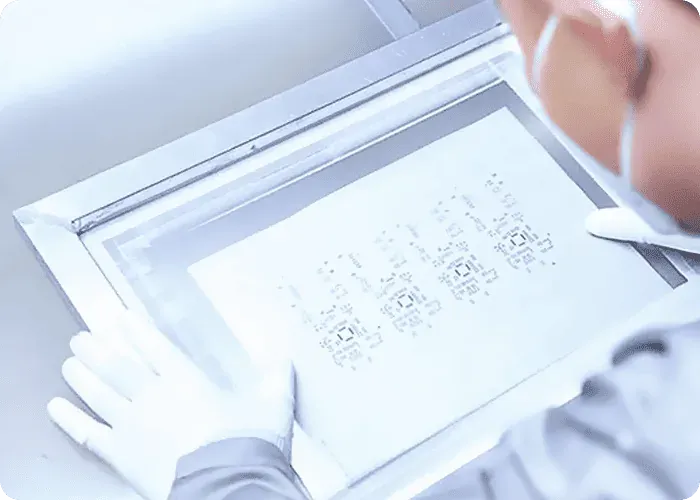
Metal stencil: a single sheet of metal foil, usually stainless steel, with through-apertures made by laser cutting, electroforming or similar methods to match the pads. The apertures are fully open, with no threads in the way. A framed stencil is normally tensioned by a border of mesh glued to an aluminium frame; that mesh only provides tension and is not part of the print area.
That border is the main source of confusion. A framed stencil does have "mesh" around the edge, but the print area is solid foil, so the printing principle is no longer screen printing. For frame and tensioning choices, see SMT stencil material, frame and tension selection.
What sets paste volume
This is the core process difference.
- Mesh screen: deposit thickness is set mainly by the mesh and emulsion thickness together. The threads block part of each opening, and the paste has to level out after the squeegee passes to fill the gaps the threads leave. The smaller the feature, the larger the share blocked by threads and the harder it is to keep volume stable.
- Metal stencil: deposit volume is roughly aperture area times foil thickness, adjusted by release behaviour. The ratio of aperture opening to aperture wall area governs whether paste releases cleanly; see stencil aperture area ratio and paste release.
Put simply, screen paste volume is constrained by the mesh, while stencil paste volume can be designed directly through aperture size and foil thickness.
Why SMT solder paste printing uses stencils
As pads shrink and pitch tightens, paste-volume consistency directly drives joint quality. Stencils have structural advantages here:
- Unobstructed apertures: small openings are not partly blocked by threads, so fine-pitch volume is easier to control.
- Volume designed per pad: aperture scaling and step stencils let different components on one board receive different volumes; see step stencil multilevel aperture design.
- Paste is not limited by mesh openings: a screen's openings restrict which particles and rheologies pass through; open stencil apertures accept a wider paste range.
- Cleaning and life: solid foil tolerates underside wiping and offline cleaning, with no emulsion to wear or lift.
So when an assembly line says "print paste" today, it almost always means metal stencil printing. For the parameter window (squeegee pressure, speed, separation), see stencil printing process window.
Where mesh screens are still used
Screens have not left PCB and electronics manufacturing; they serve steps with different precision needs:
- PCB solder mask: some solder mask processes flood-coat through a screen, then expose and develop the pattern.
- Legend (silkscreen): the name "silkscreen" comes from screen printing; legend is now often inkjet-printed too, and both methods coexist.
- Carbon ink, peelable mask and other special inks: these are printed by area with relaxed opening precision, and screens remain a common tool.
- Thick-film and ceramic processes: some thick-film conductor and resistor pastes are still printed with screens.
In one factory, screens and stencils usually coexist; they simply serve different steps.
Comparison
| Item | Mesh screen (mesh + emulsion) | Metal stencil |
|---|---|---|
| Print-area structure | Woven mesh + emulsion pattern | Solid foil with apertures |
| Paste volume set by | Mesh and emulsion thickness, thread blockage | Aperture area × foil thickness, release |
| Fine-pitch pads | High thread share, hard to stabilise | Suited, apertures designed by area ratio |
| Local volume changes | Limited | Aperture scaling, step stencil |
| Typical uses | Solder mask, legend, carbon ink, thick-film pastes | SMT solder paste, some adhesive printing |
How to state it in documents and RFQs
- For solder paste, write "SMT stencil / laser-cut stencil" and state framed or frameless, frame size and thickness requirement, not "screen".
- If you genuinely need a screen (for special inks or adhesive), state its purpose and the paste type separately.
- Supply the paste layer file, not just the solder mask layer; see stencil data package: from paste layer to cut file.
The scope of SKPCB's stencil service is on the SMT stencil service page, and you can request a quote for an assessment.
Summary
A screen is mesh plus emulsion; a stencil is foil plus apertures. Screen paste volume is constrained by the mesh, which suits solder mask, legend and special inks. Stencil paste volume can be designed per pad, which makes it the mainstream tool for SMT solder paste. Keeping the two terms separate in process documents saves a round of clarification.
FAQ
Q: Is "screen printing" in SMT the same as stencil printing?
A: The terms are mixed in speech, but the tools differ. SMT solder paste printing today essentially uses metal stencils; a screen is a mesh-and-emulsion mask. Write "stencil" in documents.
Q: A framed stencil has mesh at the edge. Why is it not a screen?
A: The border mesh only tensions the foil on the frame. The print area is solid foil with apertures, and the paste passes through no threads.
Q: Can solder paste be printed with a screen?
A: It can, but threads block the openings and restrict paste flow, so fine-pitch volume is hard to stabilise. Mainstream SMT lines do not use it.
Q: What determines stencil paste volume?
A: Roughly aperture area times stencil thickness, adjusted by area ratio and release behaviour.
Q: Is PCB "silkscreen" screen printing?
A: The name comes from screen printing. Legend is now printed by screen or by inkjet, depending on the factory process.
Q: What if one board needs different paste volumes?
A: Use aperture scaling or a step stencil. A screen can hardly create local volume differences.